

How to Keep Coffee Beans Fresh: A 2026 Guide
Table of Contents
- Why Coffee Beans Go Stale: The Four Enemies of Freshness
- How Long Do Coffee Beans Stay Fresh?
- Coffee Bean Storage After Opening: Your First 24 Hours Matter
- The Best Container for Coffee Beans: What Actually Works
- Can You Freeze Coffee Beans? Yes, With These Rules
- Why the Refrigerator Ruins Coffee (and What to Do Instead)
- Storage for Different Roast Levels and Environments
- Sustainable Storage Solutions That Keep Beans Fresh
- Frequently Asked Questions
Last Updated: October 7, 2026
Why Coffee Beans Go Stale: The Four Enemies of Freshness
Learning how to keep coffee beans fresh starts with understanding what you're fighting. Roasted coffee is a perishable product.
Air causes oxidation, the same process that turns a cut apple brown. Oxygen reacts with the oils inside the bean and strips away the compounds that create aroma and flavor.
Heat pushes all of these reactions into overdrive. Every ten degrees of extra warmth makes oxidation happen faster.
Air, Moisture, Heat, and Light: How Each One Affects Your Beans
Each enemy attacks differently, so each one needs its own defense.
- Air: Causes oxidation, which flattens flavor and kills aroma
- Moisture: Gets absorbed by porous beans, speeding up staling
- Heat: Accelerates every chemical reaction, including the bad ones
The fix is simple in theory: block all four at once. In practice, that means an airtight, opaque container kept in a cool spot. The U.S. Department of Agriculture's food storage guidance makes the same point about heat and moisture for shelf-stable foods.
How Long Do Coffee Beans Stay Fresh?
Whole beans stay fresh for about two to four weeks after the roast date when stored in an airtight container at room temperature. Pre-ground coffee goes stale in days, not weeks, because grinding exposes far more surface area to oxygen.
That freshness window shrinks fast with poor storage. A bag left open on the counter can taste flat within a week.
Freshness Windows by Roast Level
Roast level changes the timeline. Dark roasts have more oil on the surface, so they oxidize faster. Light roasts hold up longer because their oils stay locked deeper inside the bean.
| Roast Level | Peak Freshness (Whole Bean) | Notes |
|---|---|---|
| Light roast | 3-4 weeks | Denser bean, slower oxidation |
| Medium roast | 2-3 weeks | Balanced oils and density |
| Dark roast | 1-2 weeks | Oily surface, oxidizes fastest |
Buy in amounts you'll finish within the window. That's the single easiest habit to build.
Coffee Bean Storage After Opening: Your First 24 Hours Matter
The first day after opening a bag sets the tone for everything that follows. Once you break the seal, the clock starts. Carbon dioxide from roasting has mostly escaped by now, so the beans are ready to absorb whatever's around them.
Here's what to do in that first day:
- Move beans out of the original bag unless it reseals tightly
- Pick an airtight, opaque container that blocks light
- Store it in a cool, dark cabinet away from the stove
- Keep the container sealed between scoops
- Note the roast date so you can track the freshness window
A common mistake is leaving the bag rolled shut with a clip. That's better than nothing, but air still seeps in. A true airtight seal does more work.
The Best Container for Coffee Beans: What Actually Works
The best container for coffee beans is an opaque, airtight canister with a tight-fitting lid. That combination blocks all four enemies at once: air, moisture, heat, and light.
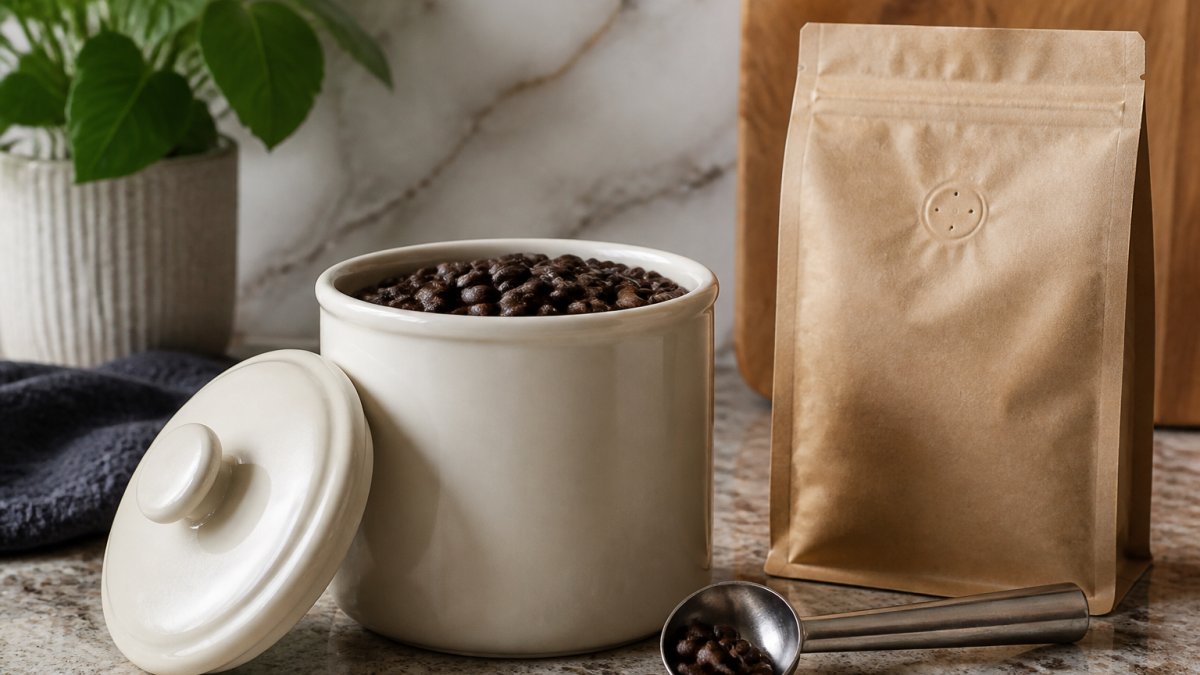
Materials that work well, and what each one actually does:
- Ceramic: Opaque, blocks light, and holds temperature steady because the walls are thick. Heavier than steel, and it can chip if dropped.
- Stainless steel: Durable, airtight, easy to wipe clean, and fully opaque. It can pick up odors if you store anything else in it, so keep it coffee-only.
- Opaque glass or tinted glass: Blocks most light while letting you see how much is left. Less insulating than ceramic or steel, so it warms up faster near a stove.
Skip clear glass, thin plastic bags, and decorative tins with loose lids. None of them seal well enough to matter, and clear glass adds a light problem on top of an air problem.
Match the Container to the Roast
Roast level should shape what you buy, not just how you store it. Dark roasts carry more oil on the surface, so they oxidize faster and benefit most from a true vacuum seal or a tightly packed, small container that limits headspace.
A practical rule: the darker and oilier the bean, the less air you want touching it, and the smaller the container should be relative to how much coffee is inside. Headspace is oxygen, and oxygen is the enemy.
The One-Way Valve Bag: Why It Exists and When to Keep It
A one-way valve bag lets carbon dioxide escape while keeping oxygen out. Roasted beans release CO2 for days after roasting, and without a valve, that gas would puff up the bag or force it open.
Keep beans in the valve bag if you'll finish them within a week or two. The bag handles degassing well and blocks light if it's opaque.
A Quick Container Checklist
Before you commit to a container, run through these:
- Does the lid seal with a gasket or a tight twist, not just a resting fit?
- Is the body opaque, or at least heavily tinted?
- Is it sized so beans fill most of the volume, leaving little headspace?
- Can you clean it fully so old oils don't turn rancid and flavor the next batch?
- Does it fit in a cool, dark cabinet away from the stove?
If the answer to all five is yes, you've solved the container problem. The rest is habit.
Can You Freeze Coffee Beans? Yes, With These Rules
Freezing is one of the best ways to keep coffee beans fresh for the long haul, but only if you do it right. The key is to freeze beans in small portions and never thaw and refreeze them. Each thaw cycle pulls moisture onto the bean surface.
Follow these rules:
- Divide beans into one-week portions before freezing
- Seal each portion in an airtight, opaque container or vacuum bag
- Label each with the roast date
- Take out one portion at a time
- Let it come to room temperature before grinding
Whole beans freeze better than pre-ground. Grinding before freezing exposes oils and speeds up staling once thawed.
Avoiding Freezer Burn and Condensation
Freezer burn happens when air reaches the beans and dries them out. Condensation happens when cold beans meet warm, humid air. Both ruin flavor.
The fix is a true airtight seal and a slow thaw. Keep the container closed while it warms up. Opening it early lets moisture condense right onto the beans.
Why the Refrigerator Ruins Coffee (and What to Do Instead)
The refrigerator is the worst place for coffee beans. It's humid, it holds strong odors, and every open-and-close cycle causes temperature swings.
The U.S. Food and Drug Administration's refrigerator and freezer guidance notes that fridges cycle through humidity and temperature changes, which is exactly what coffee can't handle.
Store beans in a cool, dark pantry instead. Aim for a spot away from the stove, oven, and direct sun.
Storage for Different Roast Levels and Environments
Storage isn't one-size-fits-all. Roast level and your local climate both change the rules. This is the part most guides skip, and it's where a little tuning pays off.
Roast Level Changes the Clock
Dark, oily beans need tighter seals and shorter storage windows. Their surface oils are already exposed, so oxygen goes to work immediately. Light roasts are more forgiving because their oils sit deeper inside a denser bean.
A simple way to think about it: the oilier the bean looks, the more aggressively you should seal it. If you can see a sheen on the beans, treat them like a short-shelf-life item and buy smaller amounts.
How Altitude and Humidity Change the Game
Altitude and humidity both affect how fast beans stale, and they pull in opposite directions depending on where you are.
- Humid climates: Moisture is the main threat. Beans are porous and soak up water from the air, which speeds staling and can invite mold. Airtight seals matter even more here, and a vacuum seal or a small desiccant pack inside the container helps. Check beans for clumping or a dull, soft feel, early signs of moisture uptake.
- Arid climates: Air is dry, so moisture is less of a concern, but temperature swings between day and night can still push oxidation. A basic airtight canister in a cool cabinet usually does the job. Don't over-engineer with desiccants you don't need.
- High altitude: Lower air pressure means sealed containers can build pressure differently, and beans may degas faster. If you're at elevation, burp rigid containers occasionally and avoid over-tightening lids that could pop. Flexible valve bags handle the pressure change more gracefully than hard canisters.
A simple approach: match your container to your climate. Humid area? Vacuum seal or add a desiccant pack. Dry area? A basic airtight canister does the job. High altitude? Favor flexible valve bags over rigid sealed jars.
A Climate-and-Roast Cheat Sheet
| Situation | Priority | Practical Move |
|---|---|---|
| Dark roast, humid climate | Block moisture and air | Small vacuum-sealed portions, desiccant pack |
| Dark roast, dry climate | Block air and heat | Tight airtight canister, cool cabinet |
| Light roast, humid climate | Block moisture | Airtight canister with a gasket, keep closed |
| Light roast, dry climate | Block light and heat | Opaque canister, away from the stove |
| High altitude, any roast | Manage pressure | Flexible valve bags, burp rigid containers |
Sustainable Storage Solutions That Keep Beans Fresh
You don't have to choose between fresh coffee and less waste. Reusable containers, refillable bags, and compostable packaging all keep beans fresh while cutting down on trash.
Options worth trying:
- Reusable stainless steel canisters: Last for years, block light and air
- Refillable valve bags: Reuse the one-way valve design without new plastic
- Compostable packaging: Breaks down after use, no landfill waste
Pair these with a simple habit: buy only what you'll drink within the freshness window. Less waste, fresher coffee, and a smaller footprint all at once.
Frequently Asked Questions
How long can whole coffee beans stay fresh?
Whole coffee beans stay fresh for about 2 to 4 weeks after the roast date if stored in an airtight, opaque container at room temperature. After that, oxidation and degassing begin to flatten the flavor. For longer storage, freezing extends freshness to 2 or 3 months without losing aroma. Always check the roast date on the bag, not the best-by date, to judge true freshness.
Does keeping coffee beans in the freezer keep it fresh?
Freezing can keep coffee beans fresh for up to 3 months if done correctly. Use a vacuum-sealed bag or an airtight container, remove as much air as possible, and place it in the coldest part of the freezer. Never thaw and refreeze the same beans, because condensation forms each time and speeds up staleness. Take out only what you need for a few days and let it come to room temperature before grinding.
Is it okay to store coffee beans in a Ziploc bag?
A standard Ziploc bag is not ideal for long-term coffee storage. It lets in air and light, and it does not create a strong enough seal to block moisture. If you must use one, squeeze out all the air before sealing and keep it in a dark cupboard. For better results, transfer beans to an opaque, airtight container with a one-way valve or a vacuum seal.
Should you grind coffee beans before storing them?
Grinding coffee beans before storing them speeds up staleness dramatically. Once ground, the surface area increases and volatile compounds escape within hours. Whole beans retain their flavor profile for weeks, while pre-ground coffee loses peak freshness in days. For the best cup, grind only the amount you need right before brewing. If you must pre-grind, store it in an airtight container in the freezer and use it within a week.
Keeping coffee beans fresh comes down to one thing: control. Control air, moisture, heat, and light, and your beans reward you with flavor that lasts. At Pups Brew, we make that easy with single-origin beans and curated sample packs delivered to your door, plus free shipping on every order. Our airtight-friendly packaging and fresh roast dates mean your beans arrive ready to store right. Get started with Pups Brew and taste what fresh coffee should be.